


Feng was widely considered one of the top Command and Control (C2) and artificial intelligence expert in both China and the People’s Liberation Army (PLA). Furthermore, he was a Colonel in the People’s Liberation Army Strategic Support Force (PLASSF) and held several important positions in the PLA.
On July 1st, Feng Yanghe 冯旸赫 –– died due to injuries sustained in an early morning car accident in the city of Beijing. However, the Chinese Association for Artificial Intelligence 中国人工智能学会 released a statement about his death on July 15th, fourteen days after his death. The People’s Liberation Army (PLA) held his cremation in the Lan Hall of Beijing Babaoshan Funeral Home—an act that is usually reserved for vice ministers and above. Feng was widely considered one of the top Command and Control (C2) and artificial intelligence expert in both China and the People’s Liberation Army (PLA). Furthermore, he was a Colonel in the People’s Liberation Army Strategic Support Force (PLASSF) and held several important positions in the PLA.
Rumors Surrounding Feng’s Death and Funeral
Feng’s death sparked several rumors to appear on Chinese social media and Internet about how he died and his funeral arrangements. The various rumors, include why he was traveling at an unusual hour when he died, the reason why he was in Beijing, his obituary, and funeral. Numerous individuals pointed out that Feng used the Didi ridesharing app – Chinese version of Uber but contains more features such as financial services – to return to where he was staying at while in Beijing. However, there are two points of contention regarding why he took the Didi; with some saying he used the ridesharing service because he just arrived in Beijing earlier that night to work on a ‘major task’ for the PLA. Other rumors say Feng used the service to return from his workplace since he was known to have long working hours — anywhere from 10 to 14 hours a day – and was simply too tired to drive home. Other commenters mentioned that relatively few vehicles would be driving during this time in Beijing and questioned what caused the accident and the seriousness of the accident.
The exact reason for Feng being in Beijing also caused several rumors to appear because he is an assistant professor at the National Defense University of Technology 中国人民解放军国防科技大学 in the city of Changsha. Feng reportedly traveled to and was in Beijing because the Central Military Commission (CMC) reportedly summoned Feng to the city to work on a ‘major task.’
The exact reason for Feng being in Beijing also caused several rumors to appear because he is an assistant professor at the National Defense University of Technology 中国人民解放军国防科技大学 in the city of Changsha. Feng reportedly traveled to and was in Beijing because the Central Military Commission (CMC) reportedly summoned Feng to the city to work on a ‘major task.’ However, there is no information regarding what the ‘major task’ was, why the CMC summoned him so quickly, or which PLA branch it was for. Several rumors involve foreign agents killing Feng and staging car to look like it was an accident. Other rumors revolve around unknown robbers robbing and killing Feng during his trip back to his temporary residence. However, several of the commentators pointed out that security guards would have likely traveled with him during his stay in the city due to his fame and importance to the PLA.
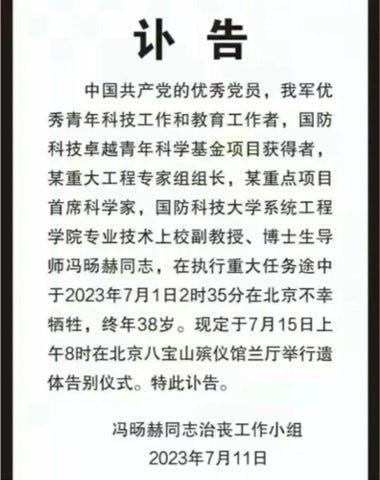
Feng’s obituary and funeral were also a source of rumors for various reasons, from the words used to where his funeral was held. The writers of Feng’s obituary used sacrificed 牺牲 when describing how he died instead of passed away 逝世 or died in the line of duty 因公殉职.
Feng’s obituary and funeral were also a source of rumors for various reasons, from the words used to where his funeral was held. The writers of Feng’s obituary used sacrificed 牺牲 when describing how he died instead of passed away 逝世 or died in the line of duty 因公殉职. His obituary was very vague and consisted of only one paragraph that vaguely explained Feng’s background, work experience, and his published works. Furthermore, the obituary also did not mention any of the AI programs Feng created for use by the PLA. Feng’s cremation also caused several rumors because of the location where it was held in Babaoshan Funeral Home. The cremation for Feng was held in the Lan Hall of the funeral home on July 15th. The Chinese Communist Party’s (CCP) Detailed Rules for Funeral Handling 喪事辦理工作細則 states that only party members or PLA officers who either held vice minister or similar positions can only be cremated in the hall. However, party authorities allowed Feng to be cremated in the hold even though he did not hold either a party rank or PLA officer rank.
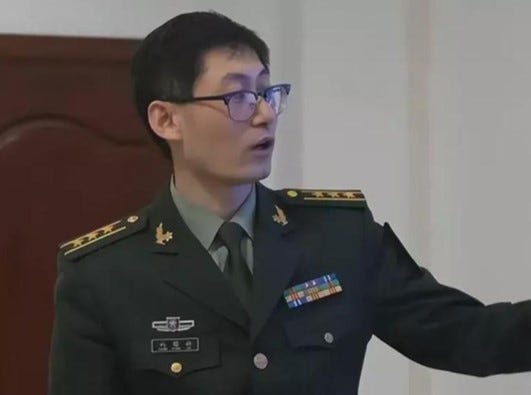
Feng’s Education and Research Background
Feng began to conduct research into and publishing papers on AI and related fields such as algorithms to create and improve decision support systems by 2009. Feng then began his Ph.D. in 2010, specializing in system modeling and analysis and began to be known in domestic and foreign academic circles. He also worked as an assistant researcher at Harvard University’s Department of Statistics and University of Iowa’s High Performance Computing Laboratory from 2011 to 2013 as part of a joint training program with the NUDT.
Feng education began in 2003 when he enrolled at National Defense University of Technology (NUDT) 国防科技大学任教 to study command automation engineering. After completing his bachelor’s degree, Feng was commissioned into the PLA as a second lieutenant 少尉 in 2007. Feng began to conduct research into and publishing papers on AI and related fields such as algorithms to create and improve decision support systems by 2009. Feng then began his Ph.D. in 2010, specializing in system modeling and analysis and began to be known in domestic and foreign academic circles. He also worked as an assistant researcher at Harvard University’s Department of Statistics and University of Iowa’s High Performance Computing Laboratory from 2011 to 2013 as part of a joint training program with the NUDT. Feng then returned to China where he graduated with his Ph.D. from the NUDT in 2014. He then stayed at the university where he was an assistant professor and doctoral supervisor at its School of Systems Engineering.
The CMC also chose Feng to be the assistant leader of its Artificial Intelligence Specialized Group of Weaponry and Equipment of the Ministry of Equipment Development; the secretary of the intelligent C2 group; and a key project expert of the CMC’s Science and Technology Committee. He was the vice president of the Computational Intelligence Branch of the Operations Research Society of China. Feng was also a member of the Intelligence Command and Control System Engineering Specialized Committee of the Chinese Allegation Society.


Feng’s research mainly focused on the areas of reinforcement learning, intelligent gaming, intelligent planning, military simulation and deduction technology, and Bayesian theory. Specifically, his research focused on how to assist operational decision-making and to combine various domains – such as land, air, sea, cyber, and space – into an integrated combat command. He started writing and publishing papers about his research in 2009 with him collaborating and writing at least 60 peer-reviewed papers in both China and abroad. Feng also wrote and published four books on certain aspects of AI. He also made several significant breakthroughs in C2 and intelligent decision-making which earned him several domestic and foreign awards.


War Skull and War Skull Two
Feng was the chief designer led the design team for War Skull 战颅 and War Skull Two 战颅二号—two intelligent decision-making models developed for the PLA that continuously learned through intelligent learning. The team first created War Skull in 2019 and revealed it at the 3rd National War Game Deduction Competition’s Man-Machine Challenge in the city of Changsha. The program defeated all 48 players during 36 interactions of the final round of the challenge. Feng said that War Skull was based on intelligent system engineering and combines various methods such as knowledge reasoning; supervised learning; semi-supervised learning; integrated learning; and reinforcement learning. The program will use the aspects to build an intelligent decision-making model and use of the big data and results generated from previous confrontations to continuously improve and train the program. The team led by Feng further refined the original War Skull program to produce War Skull Two, where it was used at the 4th National War Game Deduction Competition’s Man-Machine Challenge in 2020. The improved system defeated all players in the competition.
In 2021, an AI decision-making system based off War Skull Two was incorporated by the PLA for use by ten departments belonging to various Theater Commands, various PLA units, and supported various military exercises. The AI program is also reportedly in use by several national defense companies throughout China. The software can draft operation plans, complete risk assessments, and provide alternative plans based off incomplete tactical data. The agent can also directly issue orders to fighter aircraft, naval vessels, main battle tanks, etc. to launch attacks under the system’s command and can adjust to changes in the battlefield situation.
Analysis: The death of Feng Yanghe is a profound loss for the PLA and will likely set any research into creating and improving AI programs to assist commanders in decision-making. The PLA is emphasizing the incorporation and use of AI programs to make decisions at the strategic, operational, and tactical levels for several reasons. The most significant reason is because the CCP believes that programs such as War Skull and War Skull Two will allow commanders to make decisions without giving them too much control. Furthermore, it would also allow the PLA to supplement intelligence analysis without the need to train intelligence analysts to critically think and thus increase control over them.
The development of these programs also fit into the matter that the PLA will fight wars. Future PLA units will be based on synthetic brigades 合成旅—units that includes all combat and support units of previously found at division-level. However, these synthetic brigades will take on significantly more combat intensive tasks than the division-level units in the past. The PLA already use these types of units throughout the PLA and reportedly beaten a Russian Army regiment during a previous joint exercise using units from a brigade. The programs will assist the PLA in incorporating these brigades because it will increase the brigade’s ability to digest and analyze the significant amount of information the unit receives in real-time. It would also increase the PLA’s ability to conduct joint operations between the brigade’s subordinate units, neighboring units, and other branches – such as the People’s Liberation Army Navy and People’s Liberation Army Air Force – on the battlefield.
The rumors that surround Feng’s death are likely unfounded and are based on how local authorities handled his death and funeral. For example, he likely died because of the Didi driver crashing his car due to fatigue and not at the hands of foreign agents or robbers. The writers of Feng’s obituary used the term sacrificed because his death did not meet the criteria for them to use died in the of duty because that is more applicable to combat related deaths. Finally, party authorities allowed Feng’s cremation to occur in the Lan Hall is because he was such as significant figure and had a profound impact on the PLA’s ability to incorporate AI into the organization.